
Discover Your Dream Home: Tucson AZ Homes for Sale in 2026
The landscape of homes for sale in Tucson AZ in 2026 combines desert beauty with shifting affordability. According to Zillow data through early 2026, typical Tucson home values cluster between $300,000 and $330,000, reflecting steady appreciation over recent years. Buyers compare historic neighborhoods near Fourth Avenue and Downtown Tucson with newer communities in Rita Ranch and Corona de Tucson, balancing commute times, school access, and outdoor amenities. Understanding how these elements intersect helps clarify which properties deserve prompt attention in a competitive desert market.
How Is the Tucson Housing Market Positioned Going Into 2026?
Market conditions for homes for sale in Tucson AZ entering 2026 reflect constrained inventory and consistent demand. Based on housing data from Redfin through late 2025, the median sale-to-list ratio in Tucson has hovered around 1.00 for several quarters, indicating balanced but competitive negotiations. Many properties near Broadway Boulevard, Grant Road, and Campbell Avenue receive multiple offers within 7 to 10 days. This pace encourages buyers to clarify price ceilings, financing, and preferred neighborhoods before new listings appear.
Price ranges vary across the metro. According to Realtor.com, entry-level single-family homes in central Tucson often list between $280,000 and $360,000, while upgraded properties in the Catalina Foothills can reach between $700,000 and $1,000,000. Townhomes along River Road and communities near Rillito River Park frequently trade in the $350,000 to $450,000 range. This spread rewards close analysis of neighborhood amenities, age of construction, and long-term maintenance expectations.
Inventory patterns also frame buyer strategy. Data from Redfin shows months of supply in Tucson generally fluctuating between 1.5 and 2.5 months through 2025, well below the 5-to-6-month benchmark associated with fully balanced markets. Limited supply affects everything from offer timing to requested repairs. In practice, homes near The University of Arizona, Banner University Medical Center, and Tucson Medical Center often command premium terms because of persistent employment-driven demand.
Which Tucson Neighborhoods Stand Out for 2026 Buyers?
Neighborhood choice shapes long-term satisfaction as much as any floor plan. Central areas around Sam Hughes, Iron Horse, and Miles offer historic bungalows within walking distance of The University of Arizona campus and Fourth Avenue’s restaurants. According to Walk Score, central Tucson scores in the mid-70s for walkability, with easy access to Sun Link streetcar stops on University Boulevard and Congress Street. These corridors provide quick transit to Downtown Tucson, the Ronstadt Transit Center, and cultural venues like the Fox Theatre and Rialto Theatre.
Late afternoons along Congress Street and Scott Avenue carry the warm scent of mesquite from open grills near Hotel Congress, blending with the sharp aroma of espresso from Cartel Roasting Co. Neon signs flicker on as the sun slides behind Sentinel Peak, casting pink light over murals along Stone Avenue. The hum of live music from the Rialto Theatre mixes with streetcar bells, creating an atmosphere that makes nearby lofts and condos feel like extensions of the downtown arts scene.
North of the city center, the Catalina Foothills, including communities off Sunrise Drive and Skyline Drive, provides elevated desert views and upscale shopping at La Encantada. Families frequently compare these areas with far-east options near Sabino Canyon and Tanque Verde Road, where access to trailheads and Saguaro National Park East encourages outdoor routines. Westside buyers often examine homes near Mercado San Agustin and the MSA Annex, drawn to the combination of modern townhomes, I-10 access, and proximity to the Rillito River Park multi-use paths.
How Do Schools and Amenities Influence Property Decisions?
School performance remains a core factor in evaluating homes for sale in Tucson AZ. According to GreatSchools data for early 2026, campuses such as University High School, Basis Tucson North, and Catalina Foothills High School receive ratings between 8 and 10 out of 10, attracting focused interest from families. This demand often translates into higher price brackets and quicker contract times for homes within favored boundaries near North Swan Road, East River Road, and Craycroft Road.
Recreation and open space also shape neighborhood appeal. Reid Park, with its zoo, golf course, and broad lawns, anchors central Tucson living and supports property interest along 22nd Street and Country Club Road. To the northeast, Sabino Canyon and the adjacent Coronado National Forest trail network draw hikers and cyclists throughout the year. Access to these landscapes often justifies higher prices for homes in Sabino Canyon Heights, Ventana Canyon, and communities along Kolb Road, where mountain views and trail proximity become everyday benefits.
Healthcare and retail access round out amenity profiles. Properties near St. Joseph’s Hospital on Wilmot Road or Northwest Medical Center on La Cholla Boulevard appeal to medical professionals seeking short commutes and 24-hour services. Shopping destinations such as Tucson Mall on Oracle Road and Park Place on Broadway Boulevard concentrate national retailers, restaurants, and entertainment within minutes of surrounding subdivisions. As a result, homes within roughly 3 to 5 miles of these centers often see stable demand regardless of broader market fluctuations.
What Property Types and Price Points Dominate Tucson Listings?
Single-family residences still account for a majority of homes for sale in Tucson AZ, but attached housing continues to gain ground. According to Zillow, roughly 60% of tracked residential inventory consists of detached homes, while townhomes and condos represent about 25% to 30% of active listings in recent quarters. This variety allows first-time buyers to enter established areas like Menlo Park or Dunbar Spring through smaller footprint properties without sacrificing proximity to Downtown Tucson or the Sun Link line.
Evening descends gently over the foothills near Skyline Drive as lights flicker on across tiered patios in communities like Skyline Country Club Estates. The air holds the faint scent of creosote after a passing monsoon shower, while desert wind brushes against stucco walls and metal railings. From many balconies, residents watch headlights trace along Campbell Avenue far below, the soft hum of traffic mixing with distant coyote calls, reinforcing the quiet separation that hillside homes maintain from the city grid.
Price expectations vary sharply by location and age of construction. Based on recent listing data from Realtor.com, newly built homes in peripheral communities such as Rancho Sahuarita, Gladden Farms in Marana, and areas near Vail often start between $340,000 and $420,000. By contrast, remodeled mid-century properties in central neighborhoods near Tucson Boulevard and Treat Avenue may list in the $400,000 to $550,000 range, depending on lot size, upgrades, and guest-house potential.
How Should Buyers Evaluate Location, Commute, and Outdoor Access?
Commute patterns in Tucson remain manageable compared with many metro areas, but corridor selection still matters. According to Walk Score, transit access inside the city averages a Transit Score in the mid-40s, with higher ratings around Downtown Tucson, The University of Arizona, and the Fourth Avenue corridor. Properties within roughly 0.5 miles of Sun Link streetcar stops or major Sun Tran bus routes on Speedway Boulevard, Broadway Boulevard, and Oracle Road can reduce daily drive times and fuel costs substantially.
Outdoor access drives many 2026 relocation decisions. Homes within a 15-minute drive of trail systems at Tucson Mountain Park, Gates Pass, or Saguaro National Park West frequently attract hikers and photographers seeking sunset views over the Tucson Mountains. On the east side, properties near Old Spanish Trail and Houghton Road position residents close to trailheads leading into Saguaro National Park East. These locations also benefit from easier weekend drives to Mount Lemmon along the Catalina Highway, where cooler temperatures and pine forests provide seasonal contrast.
Multi-use paths and bike infrastructure add another evaluation layer. The Chuck Huckelberry Loop, encircling much of the city for over 130 miles, intersects communities near Rillito River Park, Santa Cruz River Park, and Pantano River Park. Homes within a short ride of the Loop appeal strongly to cyclists and runners. Proximity to well-lit segments and underpasses often outweighs slight differences in home size, particularly for buyers prioritizing daily fitness routines and car-light lifestyles over additional interior square footage.
What Strategies Help Buyers Navigate Competitive 2026 Listings?
Competitive conditions for homes for sale in Tucson AZ reward preparation more than improvisation. Based on current reports from Redfin, roughly 40% to 50% of Tucson homes have been selling above list price during recent strong quarters, particularly in central and foothills neighborhoods. Pre-approval letters, clear budget ceilings, and familiarity with typical closing costs—often totaling 2% to 4% of purchase price—enable faster decisions when new listings appear along desirable corridors like Broadway Boulevard, Swan Road, and River Road.
Inspection and appraisal timelines also influence contract strength. In a market where many homes receive offers within the first 72 hours, compressed inspection periods of 7 to 10 days are becoming common. Buyers frequently balance more flexible repair requests with higher confidence in a property’s condition, especially for newer construction in communities like Rita Ranch, Civano, and Rancho Vistoso in Oro Valley. Understanding neighborhood-specific norms around concessions, appliances, and closing dates helps align expectations ahead of negotiations.
Lifestyle fit remains the final filter. Proximity to grocery stores such as Mercado San Agustin and Tucson’s 4th Avenue Co-op, cultural venues including the Tucson Museum of Art, and parks like Himmel Park or Armory Park all factor into long-term satisfaction. Some households prioritize being within 10 minutes of The University of Arizona, while others favor a 25-minute commute from Green Valley or Marana in exchange for quieter streets and larger lots. Aligning these trade-offs with hard budget limits reduces the chance of buyer’s remorse in later years.
The $300,000 to $330,000 value range cited at the start of this guide reflects how Tucson’s 2026 market balances relative affordability with growing demand. That same bracket from the opening underscores why entry-level listings in central neighborhoods rarely linger for more than a few weeks. The Tucson Association of Realtors market statistics portal supplies monthly updates on inventory, median pricing, and contract activity across key zip codes. Buyers who register listing alerts through that platform and commit to touring promising homes within 48 hours of activation before the spring surge typically secure stronger positions in negotiations, while those delaying decisions until late summer often face reduced options, higher competition, and less favorable contract terms.
FROM OUR BLOG
Is Now a Good Time to Buy a House in Tucson? A 2026 Buyer's Guide
If you're asking whether now is a good time to buy a house in Tucson, the answer is: it depends more on your situation than on the market. There isn't a single "yes, buy now" or "no, wait" answer that applies to everyone. What's changed in 2026 is that Tucson buyers have more room to breathe than th
What $1 Buys You in Tucson vs. California vs. Texas: A 2026 Cost-of-Living Reality Check
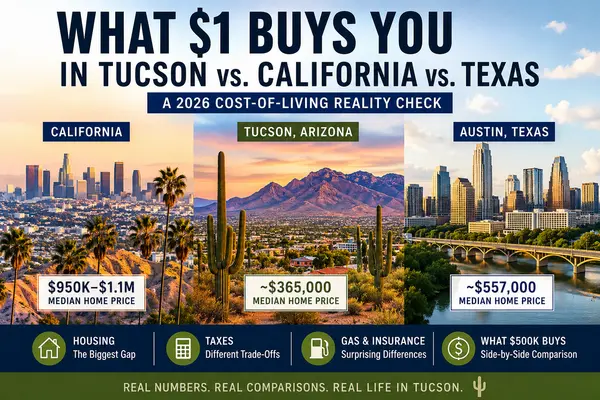
Every week I talk to someone selling a house in Los Angeles or Austin who asks a version of the same question: "Is Tucson actually cheaper, or is that just something realtors say?" Fair question. So instead of a vague answer, here's the real math — housing, taxes, gas, insurance, and everyday costs,
Vail vs. Sahuarita vs. Marana: Which Tucson Suburb Is Right for You in 2026?
Introduction After helping buyers relocate to the Tucson area for years, I've noticed a pattern: almost everyone starts by comparing two of these three towns, and almost nobody starts with all three. Military families usually pit Vail against Sahuarita because both are reasonable drives to Davis-Mon