
New Construction vs. Resale in Tucson: What Builders Won't Volunteer About Rates, Incentives, and Down Payment Help
Walk into any model home in Marana, Vail, or Sahuarita right now and the sales agent will hand you a rate that sounds almost fake. Freddie Mac has the national 30-year fixed averaging around 6.6% this week. The builder's sign out front says 3.75%. Both numbers are real. The question is what you're actually trading to get the lower one, and whether a resale home might still be the smarter buy depending on your situation.
I've walked buyers through both sides of this decision for years. Here's the honest breakdown, including the parts builders' on-site agents tend to gloss over.
The Real Cost Comparison: What Builder Rate Buydowns Actually Buy You
As of late July 2026, resale buyers financing through a conventional lender are looking at roughly 6.5% to 6.75% on a 30-year fixed. Builders, on the other hand, are subsidizing rates down to the 3.75%–4.5% range through their preferred lenders, sometimes lower on specific inventory homes they need to move. Nationally, the gap between new-construction financing and resale financing has been running close to a full percentage point.
That gap changes what you can afford, not just what you pay monthly. Because mortgage approval is based on your monthly payment relative to your income (your debt-to-income ratio), a lower rate lets the same paycheck qualify for a bigger loan. Here's what that looks like on a 30-year fixed with a fixed monthly principal-and-interest payment of about $1,896 (the payment on a $300,000 loan at 6.5%):
| Rate | Loan Amount That Produces the Same ~$1,896/mo Payment | Extra Buying Power vs. 6.5% |
|---|---|---|
| 6.5% (typical resale rate) | $300,000 | — |
| 4.5% (conservative builder buydown) | ~$374,000 | +$74,000 |
| 4.25% (common builder buydown) | ~$385,000 | +$85,000 |
| 3.75% (aggressive builder buydown) | ~$409,000 | +$109,000 |
The rates and payment examples shown throughout this article are for illustration only and are not a quote, rate lock, or guarantee. Your interest rate and monthly payment will vary based on market conditions, loan program, credit profile, and builder incentives. Always verify current rates with a licensed lender.
This is the single biggest reason new construction has closed the price gap with resale in some Tucson price bands. It's not that new homes got cheaper. It's that the financing math lets buyers qualify for more house at the same monthly payment. If you've been told you only qualify for $300,000 by a lender quoting resale rates, it's worth running the same income through a builder's preferred lender before assuming that's your ceiling.
The catch: that rate is usually a promotional buydown, not the lender's best-available rate on a resale purchase. It's a temporary or builder-subsidized incentive tied to that specific community and, often, that specific lender. Read on before you assume it's free money.
A Side-by-Side Example
Numbers make this concrete faster than percentages alone. Say you're comparing a new build listed at $425,000 with a builder-subsidized 3.99% rate against a resale home listed at $375,000 at today's roughly 6.5% market rate. On principal and interest alone (excluding taxes, insurance, and HOA dues):
| New Build | Resale | |
|---|---|---|
| Price | $425,000 | $375,000 |
| Rate | 3.99% | 6.5% |
| Est. monthly P&I | ~$2,027 | ~$2,370 |
The home that costs $50,000 more actually carries a lower monthly payment, roughly $343 less per month, because the rate does more work than the price does. This is the number that surprises most buyers standing in a builder's sales office comparing a listing price to a resale listing price without running the financing side. Always ask for the actual payment, not just the price, on both options before deciding.
Down Payment Assistance: Where New Construction Often Gets Left Out
Down payment assistance (DPA) programs are broader than most buyers realize. There are thousands of active programs nationally, and the majority of them technically allow new construction. But "technically eligible" and "usable in practice" are different things.
Most city, county, and state bond-funded DPA programs (including Pima County and City of Tucson programs) require you to close with a lender on their approved list. Builders steer buyers toward a captive or preferred lender to unlock the rate buydown and incentive package, and that lender is frequently not on the DPA program's approved list. In practice, this means you're often choosing one or the other:
- Use the builder's preferred lender and get the rate buydown, closing cost credit, or design center allowance, but give up eligibility for outside DPA funds.
- Use an approved DPA lender and qualify for down payment help, but lose access to the builder's incentive package.
Resale purchases don't have this conflict nearly as often, because you're free to choose any approved lender from the start without disqualifying yourself from a builder incentive. If down payment assistance is central to your plan, ask the builder's sales office directly, in writing, whether their preferred lender is an approved DPA lender in Pima County before you fall in love with a floor plan.
The Loan Trap: ARM vs. Temporary Buydown vs. 30-Year Fixed
This is where a builder's on-site sales agent (who works for the builder, not you) will steer the conversation toward whatever makes the payment look smallest today. Three products come up constantly:
Adjustable-Rate Mortgages (ARMs)
An ARM offers a lower rate for an initial fixed period (commonly 5, 7, or 10 years) and then adjusts, potentially upward, based on market rates. If you're planning to sell or refinance before the adjustment period ends, this can work. If you're planning to stay put and rates haven't dropped by then, your payment can jump substantially with no warning beyond the paperwork you signed years earlier.
Temporary (2-1 or 3-2-1) Buydowns
A 2-1 buydown lowers your rate by 2 percentage points in year one and 1 point in year two, then reverts to the full note rate in year three. Builders like these because the cost to subsidize them is lower than a permanent rate reduction, while the payment drop still feels dramatic to a buyer standing in the sales office. The risk is payment shock: if your income hasn't grown by year three, that jump can strain your budget fast. Ask directly whether the buydown is builder-paid (funded into an escrow account at closing) or something you're paying for through a higher price. It's frequently the former, but always confirm.
The 30-Year Fixed
Less flashy, but it's the rate you keep for the life of the loan with no reset. If a builder is offering a genuine permanent rate buydown, not a temporary one, on a 30-year fixed, that's usually the strongest version of this incentive. Before choosing an ARM or temporary buydown over it, ask the builder's lender to quote all three side by side, in writing, with the payment in year one, year two, year three, and year eight. If they hesitate to put that in writing, that's information too.
Builder Incentives Always Come With a String Attached: Their Lender
Nearly every builder incentive, rate buydown, closing cost credit, design center allowance, is contingent on financing through the builder's preferred or in-house lender. This isn't necessarily a bad deal, but it's not neutral either. That lender's whole business model is built around making the incentive attractive enough that you don't shop it elsewhere.
Before accepting: get a competing quote from an outside lender on the exact same loan structure, and ask the builder's lender for a loan estimate you can compare line by line. Sometimes the outside lender's fees are lower even after accounting for the builder credit. Sometimes they're not. You won't know until you ask for both in writing.
The Hidden Costs Nobody Tells You About
The advertised price, whether it's a builder's base price or a resale listing price, is never the full picture. Both paths carry costs that tend to surface after you've already signed.
New construction:
- Backyard landscaping (often bare dirt at closing; full landscaping can run several thousand dollars)
- Window coverings, historically an out-of-pocket add-on after closing
- Ceiling fans and light fixtures beyond builder-grade basics
- Garage door opener, if not standard on your plan
- Appliances, which some builders include and others treat as an upgrade
- Upgrade temptation at the design center, where it's easy to add $20,000–$40,000 without noticing until the final number
- HOA setup fees and, in newer master-planned communities, HOA dues that start higher and climb as amenities build out
In this market, though, a good buyer's agent can often negotiate several of these back in. Builders are working harder to win business right now, and it's increasingly common to see window coverings, a washer and dryer, or a refrigerator thrown in as part of the deal, something that wasn't the norm even a couple of years ago. It's not on the builder's price sheet; it's a concession an agent asks for on your behalf during negotiation, which is one more reason not to walk into the sales office unrepresented.
Resale:
- Roof age and remaining life
- HVAC system age and expected replacement timeline
- Water heater age
- Paint, both interior touch-ups and full exterior repaint cycles
- Flooring replacement, especially carpet and older tile
- Higher utility bills from less efficient windows, insulation, and older HVAC equipment compared to new-construction energy codes
Neither list is a reason to avoid one path or the other. It's a reason to budget for the real first-year cost of ownership, not just the number on the sign or the listing.
Builder Warranties vs. Buying a Home That's Already Been Lived In
New construction typically comes with a structural warranty (often 10 years), plus shorter warranties on systems and workmanship (commonly one and two years). That's real value: a new roof, new HVAC, new water heater, new everything, with a builder on the hook if something fails early.
Resale homes come as-is, though a seller-paid home warranty is common and negotiable, and a strong inspection contingency lets you catch problems before you own them. The tradeoff isn't warranty vs. no protection, it's a builder's warranty on unproven systems versus an inspector's eyes on a home with a track record. Both have real value; neither is automatically better.
Why You Should Bring Your Own Realtor to the Model Home
The agent sitting at the desk in the sales office represents the builder. That's not a knock on them, it's their job. They're paid by the builder to sell the builder's inventory at the builder's terms.
Here's what a lot of first-time new-construction buyers don't realize: builders almost always budget for and pay a buyer's agent commission, whether or not you bring one. If you walk in without representation, that commission typically doesn't come back to you as a discount, it just stays with the builder. You're not saving money by going it alone. You're leaving money and negotiating leverage on the table.
A buyer's agent who represents you (not the builder) can negotiate upgrades, lot premiums, closing cost credits, and pricing on your behalf, review the purchase contract for builder-favorable clauses, and help you compare the builder's lender quote against outside options. Register your agent with the builder's sales office on your first visit; most builders require the agent to be present or registered at that first contact to pay their commission later.
Tucson-Specific Considerations
Most active new-construction activity in the Tucson area right now is concentrated outside the city core, in master-planned communities in Marana (Dove Mountain, Tortolita), Oro Valley (Rancho Vistoso), Sahuarita (Rancho Sahuarita, Quail Creek), and Vail (Rancho del Lago and nearby communities), along with newer phases opening in Rita Ranch and Corona de Tucson. These areas trade shorter commutes and mature landscaping for lower price points, newer schools, and larger lots in some cases.
National builders with an active presence around Tucson include Lennar, D.R. Horton, KB Home, Meritage Homes, and Richmond American, several of them building within the Rocking K master-planned community alone. Each runs its own incentive structure, preferred lender, and design center, so the rate and terms you're quoted at a Lennar community won't necessarily match what D.R. Horton or Meritage is offering a few miles away. It's worth comparing more than one builder's current package before assuming the first one you visit has the best deal.
Resale inventory remains tighter in close-in, established neighborhoods like the Catalina Foothills and Tanque Verde, where many owners are holding onto rates well below today's market and larger lot sizes are harder to replicate in new subdivisions. If walkability, mature trees, and an established neighborhood feel matter to you, resale in these areas is still usually the better fit. If a lower effective rate, a warranty, and a brand-new floor plan matter more, new construction in the growth corridors is worth a serious look.
Builder incentives change monthly and vary by community and even by specific lot, so treat every number in this article as a starting point for your own conversation with a builder's sales office, not a guaranteed rate.
New Construction vs. Resale: Quick Decision Table
| Factor | New Construction | Resale |
|---|---|---|
| Typical financing rate (2026) | 3.75%–4.5% via builder buydown | 6.5%–6.75% market rate |
| Down payment assistance | Often conflicts with builder lender incentives | Generally easier to combine with any approved lender |
| Warranty | 10-year structural, 1–2 year systems | As-is; seller warranty sometimes negotiable |
| Negotiating room | Limited on price; more on upgrades/incentives | Price, repairs, and closing costs often negotiable |
| Timeline | Can involve a build/wait period | Move-in ready, faster close |
| Lot size and landscaping | Often smaller lots, young landscaping | Established trees, larger lots in older areas |
| Realtor cost to you | Free; builder pays if you register your agent | Free; seller typically pays via commission |
The Bottom Line
There isn't a one-size-fits-all answer here, and anyone who tells you otherwise is usually selling one side of it. Some buyers save more with a builder's financing incentives. Others come out ahead with an established resale home in the right neighborhood. The best choice depends on your budget, timeline, commute, and long-term plans, not just the advertised interest rate on the sign out front.
Not Sure Which Option Is Right for You?
Every builder incentive, resale opportunity, and financing program is different. If you're deciding between a new construction home and a resale home in Tucson, Vail, Sahuarita, Marana, or Oro Valley, I'd be happy to compare both options side by side based on your budget and goals, so you can make the decision that's best for you, not the builder.
Reach out anytime for a personalized comparison.
FAQ
Does a builder's low rate cost me anything I'm not seeing? Usually the rate buydown is funded by the builder, often by baking the cost into the home's price rather than offering it as pure savings. Compare the same floor plan's price with and without the incentive package when possible, and get an outside lender quote to check the math.
Can I still get down payment assistance on a new construction home in Tucson? Often yes, but usually only if you use a lender approved by that specific DPA program, which may not be the builder's preferred lender. Ask both the builder and the DPA program administrator directly before assuming you can combine them.
Is a 2-1 buydown or an ARM ever the right choice? It can be, especially if you're confident you'll sell, refinance, or see meaningful income growth before the rate adjusts or reverts. The risk is payment shock if none of those happen on schedule. Ask for a year-by-year payment schedule before deciding.
Do I really need a realtor if I'm buying directly from a builder? Yes. The builder has already budgeted to pay a buyer's agent commission. Skipping representation doesn't lower your price, it just means no one at the table is working exclusively for you.
Is new construction actually cheaper than resale in Tucson right now? On a monthly payment basis, often yes, because of the rate gap. On raw purchase price, it depends heavily on the specific neighborhood and lot. Run the payment math for your own income and target areas rather than assuming either category wins outright.
The rates and payment examples shown throughout this article are for illustration only and are not a quote, rate lock, or guarantee. Your interest rate and monthly payment will vary based on market conditions, loan program, credit profile, and builder incentives. Always verify current rates with a licensed lender.
FROM OUR BLOG

Is Now a Good Time to Buy a House in Tucson? A 2026 Buyer's Guide
If you're asking whether now is a good time to buy a house in Tucson, the answer is: it depends more on your situation than on the market. There isn't a single "yes, buy now" or "no, wait" answer that applies to everyone. What's changed in 2026 is that Tucson buyers have more room to breathe than th
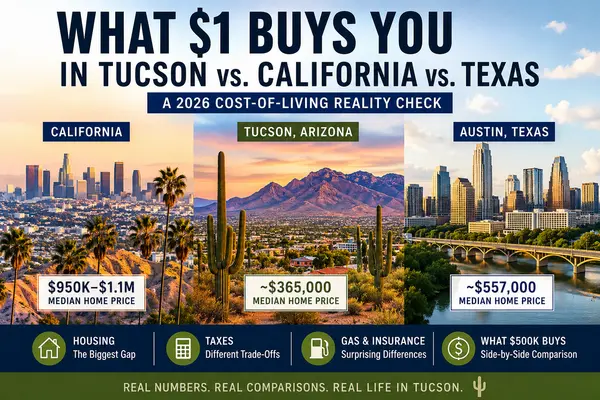
What $1 Buys You in Tucson vs. California vs. Texas: A 2026 Cost-of-Living Reality Check
Every week I talk to someone selling a house in Los Angeles or Austin who asks a version of the same question: "Is Tucson actually cheaper, or is that just something realtors say?" Fair question. So instead of a vague answer, here's the real math — housing, taxes, gas, insurance, and everyday costs,
Vail vs. Sahuarita vs. Marana: Which Tucson Suburb Is Right for You in 2026?
Introduction After helping buyers relocate to the Tucson area for years, I've noticed a pattern: almost everyone starts by comparing two of these three towns, and almost nobody starts with all three. Military families usually pit Vail against Sahuarita because both are reasonable drives to Davis-Mon