
If you're asking whether now is a good time to buy a house in Tucson, the answer is: it depends more on your situation than on the market. There isn't a single "yes, buy now" or "no, wait" answer that applies to everyone.
What's changed in 2026 is that Tucson buyers have more room to breathe than they did during the pandemic-era market. There's more inventory, homes are sitting longer, and sellers are more willing to negotiate. At the same time, mortgage rates remain elevated compared to a few years ago, so the monthly payment math matters more than ever.
Whether 2026 is a good time for you to buy comes down to your finances, your timeline, and whether you can comfortably afford the payment on a home that fits your life — not just the headlines about the market.
What the Tucson Housing Market Looks Like for Buyers in 2026
Tucson's market has shifted noticeably from the bidding-war conditions of a few years ago. Inventory has grown, and buyers are seeing more choices across most price points and property types.
A few things I'm seeing reflected in local data right now:
-
Housing supply has increased, with roughly 4.7 months of inventory recently observed across the Tucson area — a meaningful move toward balance, though not deep into buyer's-market territory.
-
Homes are generally selling for around 97–98% of original list price, so sellers are still getting close to asking, but buyers are negotiating a bit off the top in many cases.
-
Typical days on market have been running around 55–70 days, well beyond the "sold in a weekend" pace of the hottest years.
-
Buyers have more negotiating leverage than during the low-inventory years, though how much varies by neighborhood, price range, and property condition.
None of this means Tucson has flipped into a strong buyer's market. It's more accurate to call conditions balanced, with a gentle lean toward buyers in many segments.
A well-priced, move-in-ready home in a desirable area can still draw multiple offers, while an overpriced or dated listing might sit for months and see a price cut.
For a deeper look at Tucson home prices, inventory, and where the market may be headed through the rest of 2026, see my Tucson Housing Market Forecast 2026.
Why Buying in Tucson in 2026 May Make Sense
For buyers who are financially ready, current conditions offer real advantages that weren't available a few years ago:
-
More homes to choose from, instead of competing for one of two listings in your price range.
-
Less pressure to waive protections, so buyers can more often keep an inspection or appraisal contingency instead of stripping them out to compete.
-
Seller concessions are more common, including help with closing costs or buying down the buyer's rate for the first year or two.
-
Room for price negotiation, especially on homes that have been sitting on the market longer than average or have already had a price reduction.
-
Inspection negotiations are back on the table, with buyers more realistically able to ask sellers to address or credit repairs.
-
New-construction incentives, where offered. Some Tucson-area builders are using rate buydowns, closing-cost help, or upgrade incentives to move inventory, though this varies by builder and isn't universal.
What I'm seeing right now: buyers who take their time, get pre-approved, and know what they can comfortably afford are often negotiating terms that simply weren't realistic in 2021 and 2022.
The Biggest Reason Some Buyers Should Wait: Affordability
Here's the part that doesn't get said enough: getting a good deal on the purchase price doesn't matter much if the monthly payment stretches your budget too thin.
Mortgage rates remain a bigger factor in monthly affordability than they were several years ago, across nearly every price range in the Tucson area.
A buyer can negotiate a lower price, get seller-paid closing costs, and still end up with a payment that's uncomfortable once property taxes, insurance, and HOA dues (if applicable) are factored in.
This is a personal finance decision, not just a market-timing one. I'm not going to tell you what payment is right for your household — that depends on your income, debts, savings goals, and risk tolerance, and it's worth discussing with a lender and, where appropriate, a financial advisor.
What I will say is that a home can still be a good buy at a "high" price if the payment fits comfortably into your life, and it can still be a risky buy at a "great" price if it doesn't.
Should You Wait for Mortgage Rates to Drop?
This is one of the most common questions I get from Tucson buyers, and it deserves a straight answer instead of a sales pitch.
Here's the tradeoff.
If mortgage rates decline meaningfully, monthly payments become more affordable for a given loan amount — a real benefit for anyone buying at that point.
But lower rates also tend to bring more buyers back into the market at the same time, competing for the same, or fewer, available homes. That can push prices up and erode some of the negotiating leverage buyers currently have in Tucson.
In other words, waiting for rates to drop isn't a guaranteed win.
You might get a lower rate later but face higher prices, more competition, and less room to negotiate than you have today. Or rates could stay roughly where they are for longer than expected, in which case waiting mainly costs you time without producing the payment relief you were hoping for.
I'm not going to predict where mortgage rates are headed — nobody can do that reliably. What I can tell you is that today's combination of more inventory, more negotiating room, and less competitive pressure isn't guaranteed to last if rates move down significantly.
That's a real tradeoff worth thinking through, not a reason to panic into a purchase.
What Happens if You Buy Now and Rates Fall Later?
If you buy at today's rate and rates drop meaningfully later, refinancing is generally an option worth exploring at that time.
A refinance replaces your existing mortgage with a new one, ideally at a lower rate and lower payment, once it makes financial sense.
That said, refinancing isn't guaranteed. It depends on future rate movement, your credit and financial profile at the time, your home's value, and the closing costs on the new loan — all unknown today.
The right approach is to buy now only if you're genuinely comfortable with today's payment on its own terms, not because you're counting on a future refinance to make the numbers work.
If rates come down and refinancing makes sense later, that's a bonus. If they don't, you still made a decision you can live with.
Tucson New Construction vs. Resale in 2026
Both new construction and resale homes have distinct advantages in the current Tucson market, and the right choice depends on what you're looking for.
Some Tucson-area builders are competing for buyers with incentives such as:
-
Closing-cost assistance
-
Mortgage rate buydowns
-
Design-center upgrades
-
Discounts on move-in-ready inventory homes
These incentives aren't universal. They vary by builder, community, and even by specific lot or floor plan, so it's worth asking directly what's currently being offered rather than assuming every builder has the same deal.
Resale homes often provide different negotiating opportunities. Sellers motivated by a job relocation, an estate sale, or a home that's sat on the market may be more open to price reductions, repair credits, or a flexible closing timeline.
Resale also offers established neighborhoods, mature landscaping, and homes with a track record, none of which new construction can offer on day one.
For a closer comparison, see my Tucson New Construction vs. Resale guide.
Where Tucson Buyers May Find Different Opportunities
Conditions vary across the Tucson metro area, and it's worth understanding the broad differences before narrowing your search.
Tucson
Tucson offers the widest range of housing stock, price points, and neighborhood character, from historic midtown homes to newer builds on the east and northwest sides.
Vail
Vail, southeast of Tucson, continues to draw families and relocation buyers, in part due to demand for homes within the Vail School District, along with its relatively newer housing stock.
Sahuarita
Sahuarita is known for master-planned communities with amenities, including Rancho Sahuarita, appealing to buyers who want neighborhood infrastructure like parks and trails.
Marana
Marana, northwest of Tucson, has seen substantial new-construction activity and continued growth, making it a common landing spot for buyers prioritizing newer homes and builder incentives.
Oro Valley
Oro Valley generally carries higher price points, along with more established amenities and proximity to the Catalina Mountains.
Green Valley
Buyers looking farther south toward Green Valley will find different amenities and buyer demographics, so it's worth comparing lifestyle fit alongside price.
The right area depends on your commute, school priorities, lifestyle preferences, and budget more than any single market statistic.
If you're weighing several Tucson-area communities against each other, see my Vail vs. Sahuarita vs. Marana Comparison.
Who Probably Should Buy in Tucson Right Now?
Buying now tends to make sense for buyers who:
-
Plan to stay in the home for several years
-
Have stable income and finances
-
Can comfortably afford today's payment, including taxes, insurance, and maintenance, without relying on a future rate drop
-
Have found a property that genuinely fits their longer-term needs
-
Recognize the value of today's negotiating leverage and want to use it while sellers are more willing to work with buyers
Who Might Be Better Off Waiting?
Waiting can be the smarter move for buyers who:
-
Would be stretching significantly to make the payment work, with little financial cushion
-
Expect to move again within a year or two
-
Don't yet have adequate reserves for a down payment, closing costs, and an emergency fund after closing
-
Are considering buying mainly out of fear of missing out, rather than because the home and payment genuinely make sense right now
There's nothing wrong with waiting if the numbers or timing aren't right yet. A rushed purchase driven by pressure rather than readiness tends to cause more stress than it solves.
Frequently Asked Questions
Is Tucson a buyer's market in 2026?
Not entirely. Tucson's 2026 market is best described as balanced with a lean toward buyers. Inventory has grown to around 4.7 months of supply and homes are taking longer to sell, giving buyers more leverage. However, homes are still selling close to asking price in many areas, which keeps conditions from tipping fully in buyers' favor.
Are Tucson home prices expected to fall?
Current data doesn't point to a sharp decline; homes have generally been selling around 97–98% of original list price. Any specific price forecast should be treated as a prediction, not a fact.
See my Tucson Housing Market Forecast 2026 for a more detailed look at pricing trends.
Should I wait for mortgage rates to drop before buying a house?
It depends on your situation. Lower rates could reduce your future payment, but they could also bring more buyers back into the market, increasing competition and reducing negotiating room.
There's no guarantee waiting produces a better outcome, so weigh your timeline and financial readiness rather than relying on a rate prediction.
Can buyers negotiate home prices in Tucson right now?
Yes, to a degree. With homes selling around 97–98% of list price and days on market running 55–70 days, many sellers are open to reasonable offers, especially on longer-listed homes.
Negotiating room varies by neighborhood, price range, property condition, and seller motivation.
Are Tucson home sellers paying closing costs in 2026?
Some are. Seller-paid concessions toward closing costs or rate buydowns are more common than during the highly competitive years, though they're not guaranteed on every listing.
It typically depends on how long the home has been listed, the property's competition, and how motivated the seller is.
Is new construction a better deal than a resale home in Tucson?
It depends on the builder and your priorities. Some builders offer incentives like closing-cost assistance, rate buydowns, or upgrades, but not all currently do.
Resale homes often offer different negotiating opportunities and established neighborhoods that new construction can't match on day one.
How much negotiating room do Tucson buyers have?
More than during the pandemic-era market, but it varies. With roughly 4.7 months of supply and 55–70 average days on market, buyers generally have room to negotiate price, request concessions, and pursue inspection repairs.
A well-priced home in high demand can still sell quickly with little negotiation.
Thinking About Buying in the Tucson Area?
If you're considering buying in Tucson, Vail, Sahuarita, Marana, Oro Valley, or the surrounding area, I can help you look at the numbers for a specific property or neighborhood and figure out what makes sense for your budget and goals.
No pressure to move faster than you're ready to — just an honest look at what today's market means for your situation.
Ryan Porzel, REALTOR® | TucsonWithRyan.com
FROM OUR BLOG
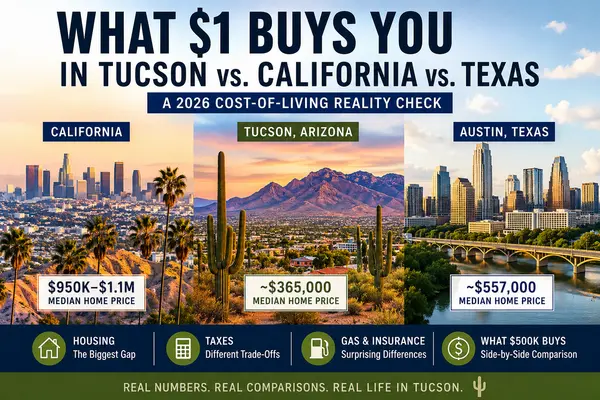
What $1 Buys You in Tucson vs. California vs. Texas: A 2026 Cost-of-Living Reality Check
Every week I talk to someone selling a house in Los Angeles or Austin who asks a version of the same question: "Is Tucson actually cheaper, or is that just something realtors say?" Fair question. So instead of a vague answer, here's the real math — housing, taxes, gas, insurance, and everyday costs,
Vail vs. Sahuarita vs. Marana: Which Tucson Suburb Is Right for You in 2026?
Introduction After helping buyers relocate to the Tucson area for years, I've noticed a pattern: almost everyone starts by comparing two of these three towns, and almost nobody starts with all three. Military families usually pit Vail against Sahuarita because both are reasonable drives to Davis-Mon
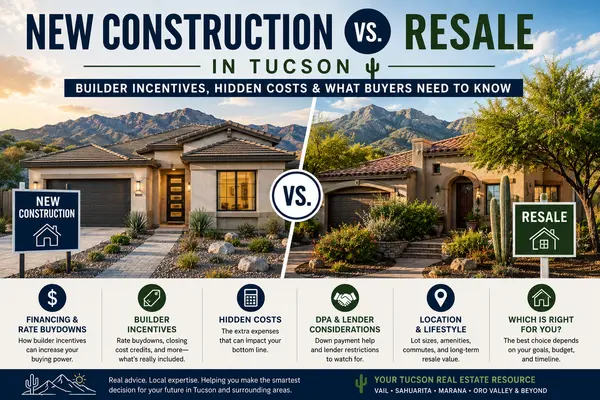
New Construction vs. Resale in Tucson: 2026 Buyer's Guide to Rates & Incentives
New Construction vs. Resale in Tucson: What Builders Won't Volunteer About Rates, Incentives, and Down Payment Help Walk into any model home in Marana, Vail, or Sahuarita right now and the sales agent will hand you a rate that sounds almost fake. Freddie Mac has the national 30-year fixed averaging